Much of Glenn's prior therapeutic work had focused on childhood trauma. His account of his upbringing was clear and consistent: his father, a former police officer and military veteran, suffered from PTSD, struggled with alcoholism, and was a deeply disturbed man who was physically and emotionally abusive toward him.
For a long time, the working theory in therapy was that Glenn's difficulty holding onto a relationship was a form of self-sabotage tied directly to his father: a fear that he would not be able to be a good father himself, or that he was destined to repeat his father's behaviour. That work had real value. Glenn came to understand that he had agency, that he was not simply a copy of his father, and that he was capable of being a good father in his own right. But even after working through this thoroughly, the pattern did not change. He still could not maintain a relationship. Something about the explanation was true, and still incomplete.
Against that, Glenn held up his mother as his source of survival. In his telling, she was loving, caring, and the one steady source of emotional support and reassurance in his life. “If it weren't for my mother,” he would say, “I would be physically dead or emotionally totally broken. My mother saved my life.” This was the story he had told, and been told back to him, for years: an abusive father, a rescuing mother, and a son who survived because of her.
In this session, rather than asking Glenn to talk further about his goal, the therapist used the Play of Life method — a technique built on a simple shift: instead of saying “tell me more,” the therapist says “show me.”
When Glenn described wanting a wife and two children, the therapist asked him to show it, using the Play of Life digital platform. Glenn built the scene: himself standing tall, his wife beside him, two children in front of them. Asked what he felt looking at it, he said it felt great — that everything he had suffered in his life finally had a purpose, and that this picture was what he truly wanted.
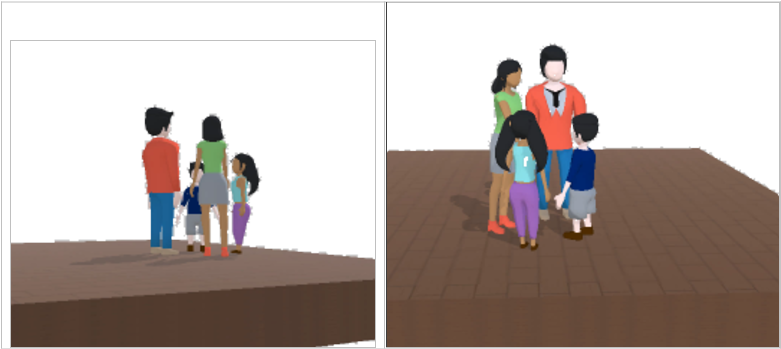
The ideal scene Glenn built: himself, his wife, and two children.
The therapist then asked what came to mind when he looked at his own family scene, in relation to his family of origin. Glenn immediately named the abuse of his father — the piece of his story he had already worked on extensively in therapy.
Again, instead of asking him to describe it, the therapist asked him to show it. Glenn quickly built a second scene: himself in a corner, frightened, with his father behind him, chasing him. It was, visibly, a moment of real fear.
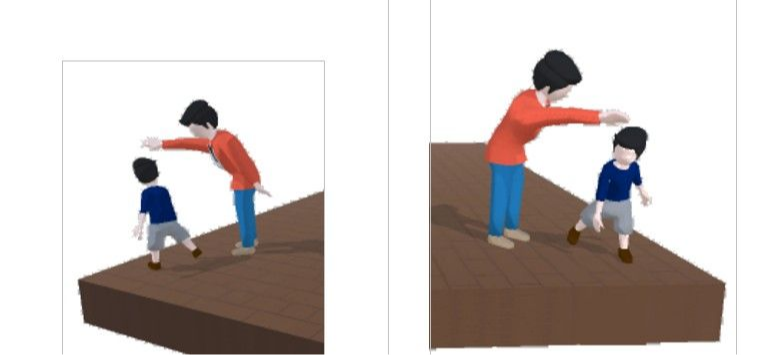
The abuse scene: young Glenn cornered as his father advances.
The Play of Life method includes a standard prompt at this point: who else is there? Glenn said there was no one else — just him and his abuser. Then came the second, sharper question the method asks: who is not there?
Glenn paused. “My mother,” he said.
He was asked to show that too. He placed a figure of his mother off to the side of the stage — and turned her face away.
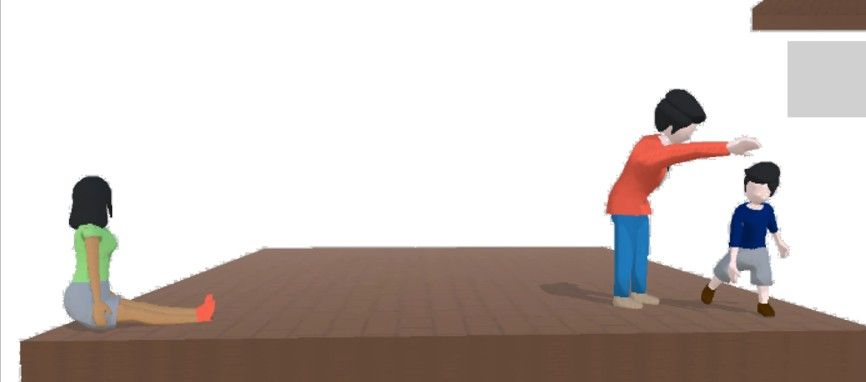
The Turn: Glenn places his mother to the side of the stage, facing away — before the therapist turns it around.
Once the mother figure was placed, the therapist turned the stage around and asked Glenn what he noticed now that she was there. Glenn looked at the scene — his father chasing him, himself cornered and afraid, his mother positioned to the side with her face turned away — and for the first time, he saw it plainly: his mother had been aware of what was happening. And she had not intervened. She was not acting to protect him from his father's abuse.
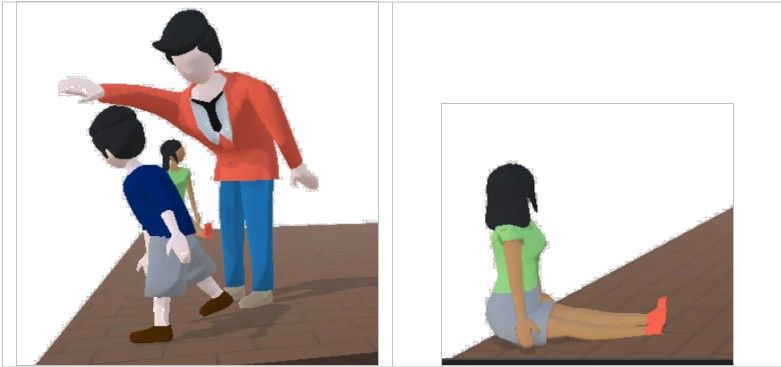
Turned around: the father-and-child scene with the previously hidden mother now visible in the background — and the mother alone, seen from behind.
This sat directly against the story he had carried for years, that his mother came to him at night, comforted him, told him stories, told him how much she loved him, and acknowledged how abusive his father was. That version was true — and it had also let him avoid seeing the rest of it. Looking at the scene he had just built, Glenn said:
“I have always seen my mother as a loving mother. But now, with this picture, I see that she neglected me. She was not helping me, not saving me — I was a child left with this abusive father.”
Glenn went quiet. After a long silence, he said, “I can't believe this. But I see it, and it makes sense.”
The realization that emerged was this: Glenn's fear in relationships was not simply about repeating his father's abuse. It was about his mother's pattern — a person who is loving, who tells him one story of care and devotion, but who, underneath, is not actually there to protect or stand by him when it counts. When a woman shows him love and he begins to trust it, that hidden picture of his mother resurfaces beneath the surface: the fear that this person, too, will speak one story while living another, and will not truly be present for him.
For years, the abusive-father narrative had absorbed all of Glenn's therapeutic attention because it was the loudest, most visible wound. Working through his fear of becoming his father, and reclaiming his sense of agency, was necessary — but it addressed the wrong mechanism. The pattern was never really about whether Glenn would repeat his father's abuse. It was about whether the person who loved him would actually stay present when it mattered, and that question pointed to his mother, not his father. Her role — quieter, more ambiguous, and protected by genuine love and good memories — had never been examined. The cognitive narrative he had built (“my mother saved me”) was true enough that it prevented him from seeing the more complicated reality sitting right behind it.
After processing the session, the facilitator asked Glenn to look again at his ideal image and asked if he would change anything. He expanded his arms, embracing his wife and children.
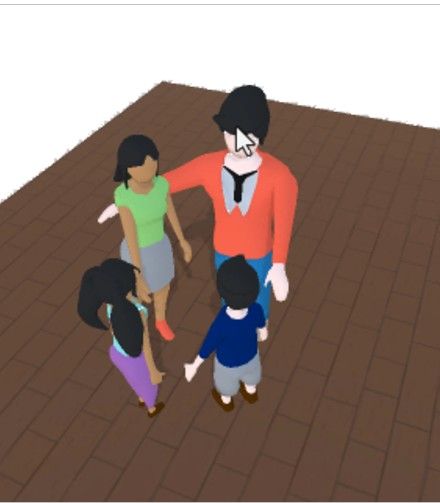
The revised ideal: Glenn expands his arms to embrace his wife and children.
The session ended with that image. Glenn was invited to take a screenshot of it and use it as the lock screen on his phone. His process continued using the Play of Life, working further on his relationship with his mother — both of his parents have since passed away. That process helped him make peace with his history, and freed him to notice what others were able to offer him without the weight of his earlier trauma. Through the Pillars of Life technique, he was also able to recover the good parts of both parents, learning to hold the constructive and the fractured roles they each played in his life.
This case illustrates the core mechanism of the Play of Life method: it bypasses the narrative. A person's spoken story is shaped by cognitive bias, self-protection, and years of repetition — the version of events that has become comfortable to tell, even in therapy. By asking someone to build the scene physically rather than describe it verbally, the method engages a different mode of processing, closer to how experience is stored before it is turned into words.
Two structural questions do most of the work here: who else is there? and, more importantly, who is not there? These questions invite the absent figures — the people written out of the narrative — back into the picture. In Glenn's case, that absent figure was his mother, standing just off the edge of the story he had told for years.
Within a matter of minutes, Glenn arrived at an insight that verbal therapy, over an extended period, had not surfaced: not by uncovering a new fact, but by seeing a familiar fact from an angle his own narrative had never allowed. This is not a failure of verbal communication — it is a trick the mind plays, trying to protect us by building a story that suits us, that comforts us. The brain does not seek truth; it seeks comfort. That is the power of bottom-up communication through the Play of Life — reaching material that talk alone, however extensive, had not been able to reach.